Restriction on Cash Transactions under Income Tax Act - Summary
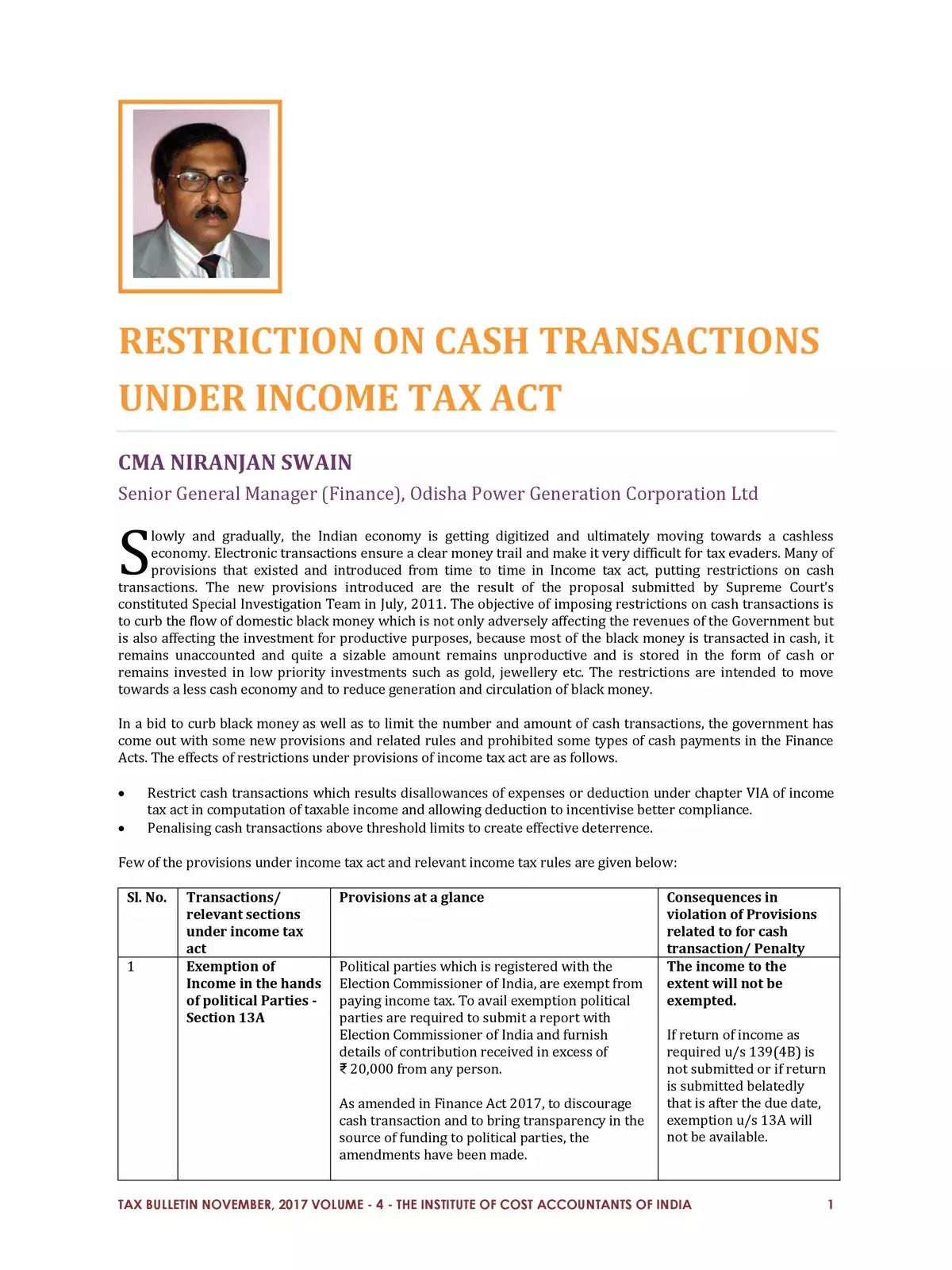
Restriction on Cash Transactions under Income Tax Act is an explanatory reference document published by the Tax Research Department of the Institute of Cost Accountants of India (ICMAI) in its Tax Bulletin (Volume 4). It outlines the statutory limits, disallowances, and monetary penalties on cash receipts, payments, loans, and deposits under the Income Tax Act, 1961.
This 6-page reference in English covers practical compliance points across ten key provisions, helping taxpayers, businesses, and professionals follow digital transaction rules and avoid heavy penalties.
Key Cash Transaction Limits and Penalties
The document details the primary thresholds enforced under Indian tax laws:
- Receipts of ₹2 Lakh or more: Section 269ST prohibits receiving ₹2 Lakh or more in cash in a single day, for a single transaction, or for one event. Contravention attracts a 100% penalty under Section 271DA.
- Loans, deposits, and advances: Section 269SS bars accepting loans, deposits, or specified property advances of ₹20,000 or more in cash, with an equal penalty under Section 271D.
- Repayment of loans and deposits: Section 269T restricts cash repayments of ₹20,000 or more, carrying a 100% penalty under Section 271E.
- Business expense disallowance: Under Section 40A(3), cash payments exceeding ₹10,000 per person per day (₹35,000 for transport operators) are fully disallowed as deductible business expenses.
- Donations and deductions: Cash donations above ₹2,000 are not eligible for deduction under Section 80G and Section 80GGA.
Verifying Tax Compliance
Taxpayers checking their compliance can review the income tax sections list or reference related tax provisions such as Section 54F rules for capital gains exemptions. Official circulars, notifications, and electronic filing utilities are accessible directly on the Income Tax Department Portal and the Central Board of Direct Taxes Portal.
How to Check Cash Transaction Limits
STEP 1 – Check the total cash amount involved in your receipt, payment, loan, or expenditure.
STEP 2 – Identify the applicable section, such as Section 269ST for general receipts or Section 40A(3) for business expenses.
STEP 3 – Make sure all transactions exceeding the threshold use banking channels such as account payee cheque, bank draft, NEFT, RTGS, or UPI.
STEP 4 – Keep formal receipts, bank statements, and invoices in your accounting records for tax audit verification.