| UGC NET Paper-I Units | UGC NET Paper-I Topics |
|---|
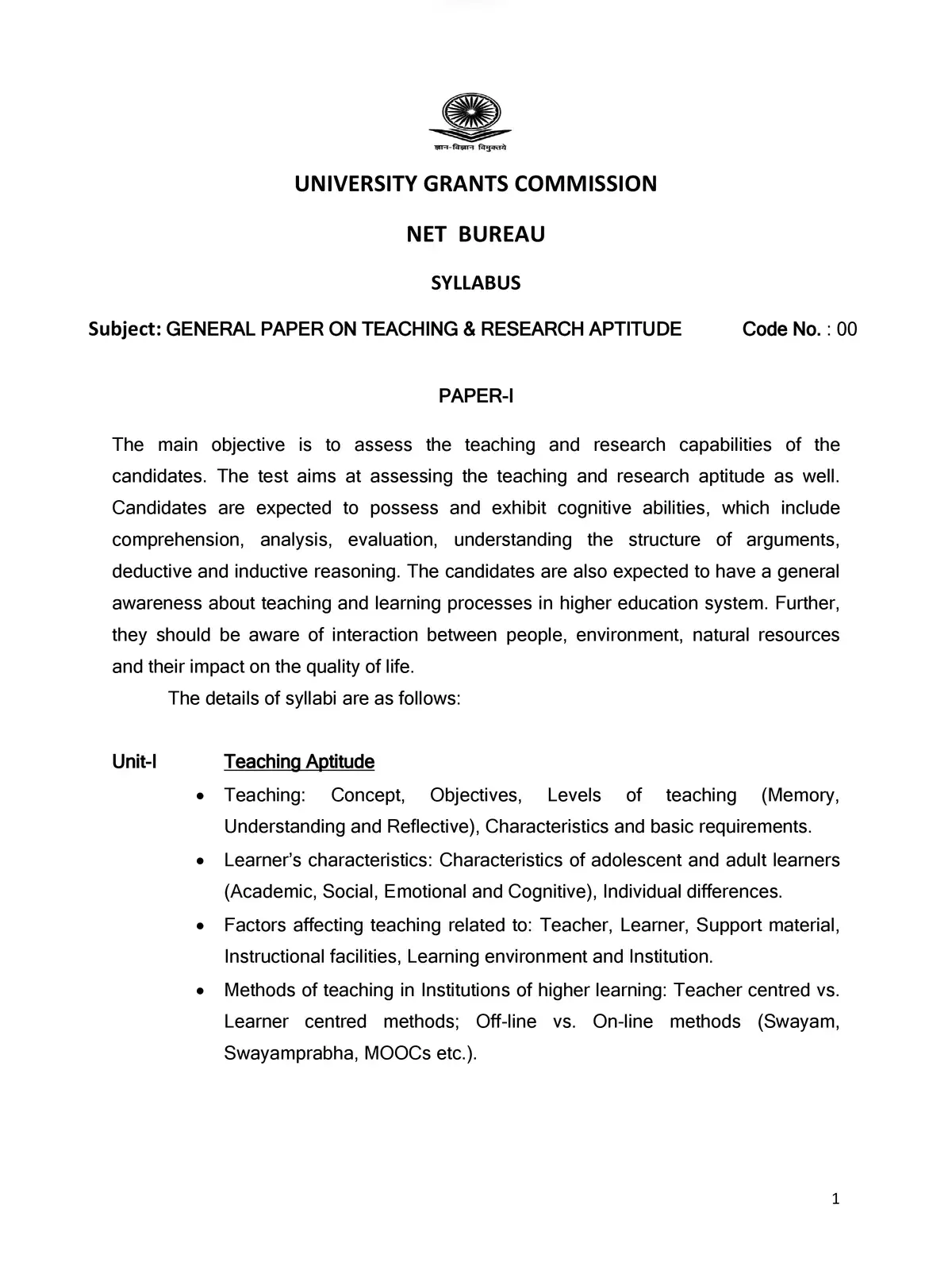
| Unit-I: Teaching Aptitude | - Teaching: Concept, objectives, levels of teaching (memory, understanding and reflective), characteristics and basic requirements
- Learner’s characteristics: Characteristics of adolescent and adult learners (academic, social, emotional and cognitive), individual differences
- Factors affecting teaching related to: Teacher, Learner, Support material, Instructional facilities, Learning environment and Institution
- Methods of teaching in institutions of higher learning: Teacher centered vs. learner centered methods; offline vs. online methods (Swayam, Swayamprabha, MOOCs etc.).
- Teaching support system: Traditional, modern and ICT based
- Evaluation systems: Elements and types of evaluation, evaluation in Choice Based Credit System in higher education, computer based testing, innovations in evaluation systems
|
| Unit-II: Research Aptitude | - Research: Meaning, types, and characteristics, positivism and post-positivistic approach to research
- Methods of research: Experimental, descriptive, historical, qualitative and quantitative methods
- Steps of research
- Thesis and article writing: Format and styles of referencing
- Application of ICT in research
- Research ethics
|
| Unit-III: Comprehension | - A passage of text be given. Questions to be asked from the passage to be answered
|
| Unit-IV: Communication | - Communication: Meaning, types and characteristics of communication
- Effective communication: Verbal and non-verbal, inter-cultural and group communications, classroom communication
- Barriers to effective communication
- Mass-media and society
|
| Unit-V: Mathematical Reasoning and Aptitude | - Types of reasoning
- Number series, letter series, codes and relationships
- Mathematical aptitude (fraction, time & distance, ratio, proportion and percentage, profit and loss, interest and discounting, averages etc.)
|
| Unit-VI: Logical Reasoning | - Understanding the structure of arguments: Argument forms, structure of categorical propositions, mood and figure, formal and informal fallacies, uses of language, connotations and denotations of terms, classical square of opposition
- Evaluating and distinguishing deductive and inductive reasoning
- Analogies
- Venn diagram: Simple and multiple use for establishing validity of arguments
- Indian Logic: Means of knowledge
- Pramanas: Pratyaksha (Perception), Anumana (Inference), Upamana (Comparison), Shabda (Verbal testimony), Arthapatti (Implication) and Anupalabddhi (Non-apprehension)
- Structure and kinds of Anumana (inference), Vyapti (invariable relation), Hetvabhasas (fallacies of inference)
|
| Unit-VII: Data Interpretation | - Sources, acquisition and classification of data
- Quantitative and qualitative data
- Graphical representation (bar-chart, histograms, pie-chart, table-chart and line-chart) and mapping of data
- Data interpretation
- Data and governance
|
| Unit-VIII: Information and Communication Technology (ICT) | - ICT: General abbreviations and terminology
- Basics of Internet, Intranet, E-mail, Audio and Video-conferencing
- Digital initiatives in higher education
- ICT and Governance
|
| Unit-IX: People, Development and Environment | - Development and environment: Millennium development and Sustainable development goals
- Human and environment interaction: Anthropogenic activities and their impacts on environment
- Environmental issues: Local, regional and global; air pollution, water pollution, soil pollution, noise pollution, waste (solid, liquid, biomedical, hazardous, electronic), climate change and its socio-economic and political dimensions
- Impacts of pollutants on human health
- Natural and energy resources: Solar, Wind, Soil, Hydro, Geothermal, Biomass, Nuclear and Forests
- Natural hazards and disasters: Mitigation strategies
- Environmental Protection Act (1986), National Action Plan on Climate Change, International agreements/efforts -Montreal Protocol, Rio Summit, Convention on Biodiversity, Kyoto Protocol, Paris Agreement, International Solar Alliance
|
| Unit-X: Higher Education System | - Institutions of higher learning and education in ancient India
- Evolution of higher learning and research in post-independence India
- Oriental, conventional and non-conventional learning programmes in India
- Professional, technical and skill-based education.
- Value education and environmental education
- Policies, governance, and administration
|