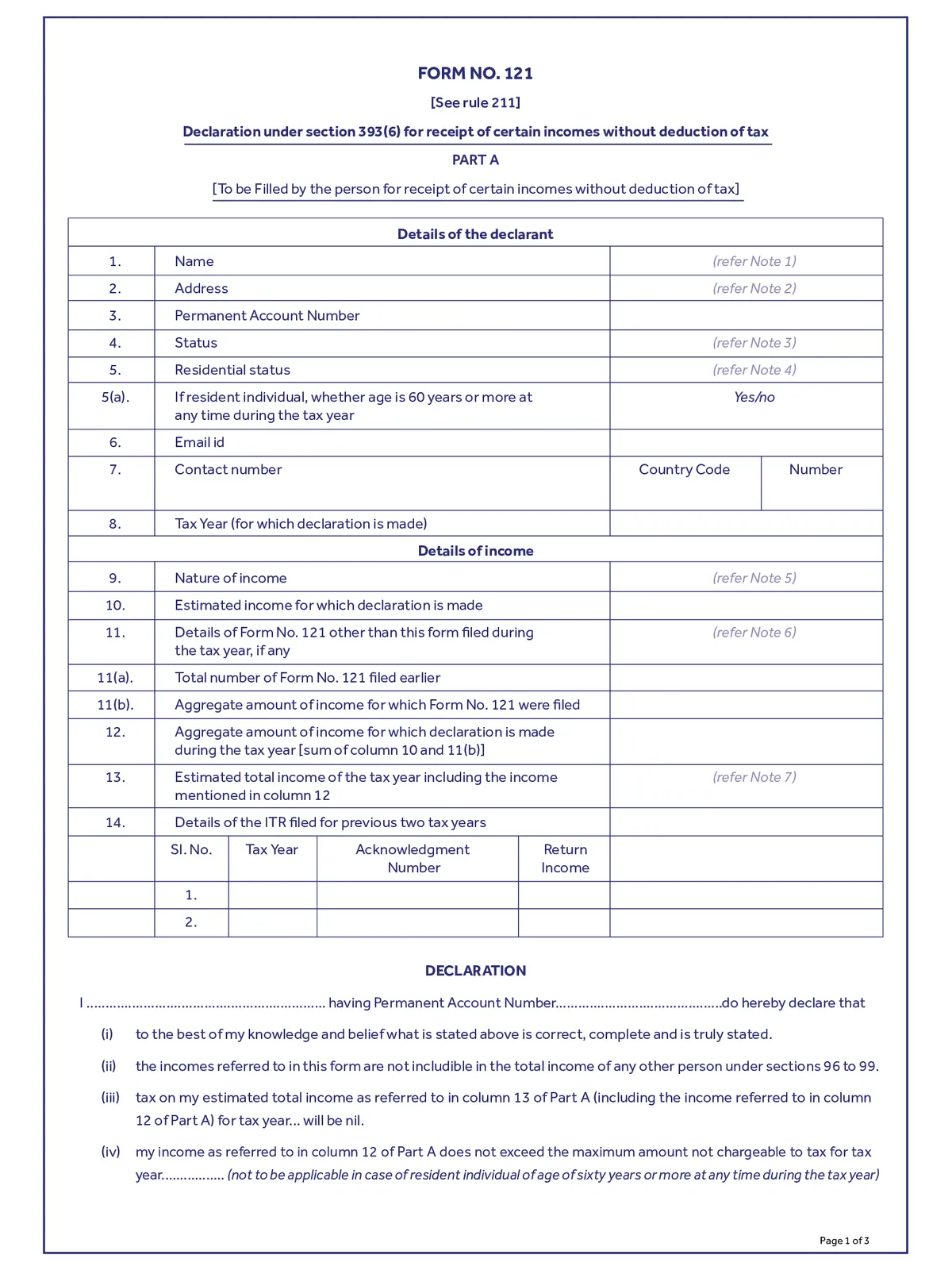
Form 121 Income Tax - Summary
Income Tax Department of India has introduced Form 121, a simplified, unified self-declaration form effective from 1st April 2026. Form 121 replaces the erstwhile dual self-declaration forms-Form 15G (for individuals below 60 years and HUFs) and Form 15H (for senior citizens). Eligible resident taxpayers whose total estimated income for the financial year is below the basic tax exemption limit can submit Form 121 to banks, post offices, and financial institutions to ensure Zero / Nil Tax Deducted at Source (TDS) on interest, dividends, and other specified payments.
Form 121 Income Tax (Self-Declaration for Nil TDS) – Highlights
| Form Name | Form 121 (Self-Declaration for Nil TDS Deduction) |
| Governing Body | Central Board of Direct Taxes (CBDT), Income Tax Department |
| Effective Date | 01 April 2026 (FY 2026-27 onwards) |
| Forms Replaced | Form 15G (General individuals/HUFs) & Form 15H (Senior citizens) |
| Core Objective | Prevent upfront deduction of TDS on non-taxable income |
| Eligible Declarant | Resident Individuals (any age group), Senior Citizens, and HUFs |
| Incomes Covered | Fixed Deposit (FD) / Recurring Deposit (RD) interest, Dividends, Bonds, Rent, EPF premature withdrawal |
| Validity Period | 1 Financial Year (Valid until March 31 of each fiscal year) |
| Submission Modes | Online (Net Banking / Mobile Banking Apps) & Offline (Branch submission) |
| Official Portal | incometax.gov.in |
Why was Form 121 Introduced? (Form 121 vs Form 15G & 15H)
Previously, taxpayers had to navigate two distinct forms based on their age bracket:
- Form 15G: Reserved for resident individuals under 60 years and Hindu Undivided Families (HUFs).
- Form 15H: Reserved exclusively for senior citizens aged 60 years and above.
This dual-form regime often created confusion among taxpayers and added processing overhead for deductors (banks and NBFCs). The introduction of Form 121 consolidates both declarations into a single smart form that dynamically captures age status, computes relevant tax exemption thresholds, and eliminates redundant paperwork.
| Feature / Parameter | Older Form 15G / 15H | New Unified Form 121 |
|---|---|---|
| Age-Based Form Selection | Separate forms required based on whether the declarant was below or above 60 years | Single unified form for all resident individual taxpayers and HUFs |
| Eligibility Verification | Manual verification of age criteria and income conditions | Streamlined verification linked to PAN and automated Aadhaar data |
| Deductor Processing | Two separate queues and filing reports for banks | Consolidated quarterly electronic reporting under single form format |
| Digital Submission | Separate options in internet banking menus | Unified “Submit Form 121” service across all major Indian banks |
Eligibility Criteria for Submitting Form 121
To submit a valid Form 121 and request non-deduction of TDS, the taxpayer must fulfill the following mandatory conditions:
- Resident Status: The declarant must be a Resident Individual or a Hindu Undivided Family (HUF). Non-Resident Indians (NRIs), partnership firms, LLPs, and companies are strictly ineligible to submit Form 121.
- Total Estimated Income Below Exemption Limit: The total taxable income of the individual during the financial year, after considering applicable standard deductions and tax rebates under Section 87A, must fall below the basic tax exemption slab.
- Estimated Tax Liability Must Be NIL: The calculated tax liability on the taxpayer’s estimated aggregate income for the relevant assessment year must be zero.
- Valid PAN / Aadhaar Card: The taxpayer must possess a valid Permanent Account Number (PAN) linked with Aadhaar. If PAN is missing, inactive, or unlinked, the deductor is required to deduct TDS at the highest rate of 20% under Section 206AA.
Incomes and Sections Covered Under Form 121
Form 121 can be furnished to request non-deduction of tax across multiple specified income streams:
| Income Tax Section | Nature of Income | Standard TDS Threshold Limit |
|---|---|---|
| Section 194A | Interest on Bank Fixed Deposits (FDs), Recurring Deposits (RDs), and Post Office term deposits | ₹40,000 for general individuals / ₹50,000 for Senior Citizens |
| Section 194A (Others) | Interest on corporate debentures, company deposits, and non-banking securities | ₹5,000 |
| Section 194 | Dividend income paid by domestic companies or equity/debt mutual fund units | ₹5,000 |
| Section 194-I | Rental income received from land, building, furniture, or equipment | ₹2,40,000 per financial year |
| Section 192A | Premature Employee Provident Fund (EPF) withdrawal prior to 5 years of continuous service | ₹50,000 |
| Section 194EE | Payments made in respect of National Savings Scheme (NSS) deposits | ₹2,500 |
Details Required in Form 121
Form 121 consists of two distinct parts. Part I is completed by the declarant, while Part II is filled by the deductor/bank:
- Declarant’s Personal Information: Full name of the individual or Karta of HUF, PAN, date of birth, and status (Individual / HUF).
- Residential Address & Contact: Flat/door number, premises, road, town, district, state, PIN code, email address, and mobile number.
- Tax Assessment History: Whether assessed to income tax under the Income Tax Act in earlier assessment years.
- Estimated Income Details: Total estimated income for which the declaration is being filed, and estimated total income of the previous year including the specified income.
- Details of Other Forms Filed: Total number of Form 121 declarations submitted to other banks/financial entities during the same fiscal year and aggregate amount of income involved.
- Self-Declaration & Verification: Formal declaration stating under penalty of perjury that the estimated income does not exceed the taxable limit.
- Part II (Deductor Section): Unique Identification Number (UIN), deductor name, TAN, branch address, and date of form acceptance.
How to Submit Form 121 Online (Bank Portal)
- Log in to Internet Banking: Access your bank’s official online portal or mobile banking app (e.g., SBI YONO, HDFC NetBanking, ICICI iMobile, PNB ONE).
- Navigate to Tax Services: Go to the e-Services or Tax / TDS Services section on the dashboard.
- Select “Submit Form 121”: Click on the link for “Submission of Form 121 (Nil TDS Declaration)”.
- Verify Pre-Filled Details: Review your auto-populated PAN, date of birth, residential status, and registered email/mobile number.
- Select Deposit Accounts: Choose the Fixed Deposit (FD) / Recurring Deposit (RD) accounts on which you seek exemption from TDS deduction.
- Enter Estimated Income: Specify your projected total income for the current financial year.
- Authenticate with OTP: Read the declaration checkbox and enter the One-Time Password (OTP) sent to your Aadhaar/bank-registered mobile number.
- Download Acknowledgement Receipt: Save and print the generated electronic confirmation bearing your Unique Identification Number (UIN).
Offline Form Submission Process
If you prefer offline submission, download the official Form 121 PDF from the link below, print two physical copies, complete Part I with signatures, and submit both copies to your local bank or post office branch. The bank teller will stamp and return one acknowledged duplicate copy for your records.
Best Time to Submit Form 121
Form 121 is valid for only one financial year. The best time to submit Form 121 is in the month of April at the beginning of each financial year. If you open a new Fixed Deposit or Recurring Deposit later in the year, you should furnish Form 121 at the time of booking the deposit to ensure that the bank does not deduct quarterly TDS automatically.
Frequently Asked Questions (FAQs)
Q1. Can senior citizens submit Form 121?
Yes. Form 121 is a unified form designed for all resident taxpayers, including super senior and senior citizens aged 60 years and above.
Q2. What happens if I forget to submit Form 121?
If you do not submit Form 121 in time and your annual interest crosses the threshold, the bank will deduct TDS and credit it to your Form 26AS / AIS. You can claim a refund of the deducted TDS by filing your Income Tax Return (ITR).
Q3. What is the penalty for submitting a false Form 121 declaration?
Under Section 277 of the Income Tax Act, submitting a false declaration knowingly to evade tax can invite prosecution, fine, and rigorous imprisonment ranging from 3 months to 7 years.
You can download the Form 121 Income Tax PDF format using the link given below.
Form 121 Income Tax PDF Download
RELATED PDF FILES-
 राजस्थान ग्राम पंचायत पट्टा फॉर्म (Rajasthan Gram Panchayat Patta Form)
-
 Odisha Ration Card Application Form Odia
-
 Punjab Ration Card Name Addition and Deletion Form Punjabi
-
 Kerala Ration Card Application Form Malayalam Malayalam
-
 UP Rural Ration Card Application Form Hindi
-
 UP Urban Ration Card Application Form Hindi
-
 Haryana Ration Card Application Form
-
 Haryana APL Ration Card Application Form D-1 Hindi