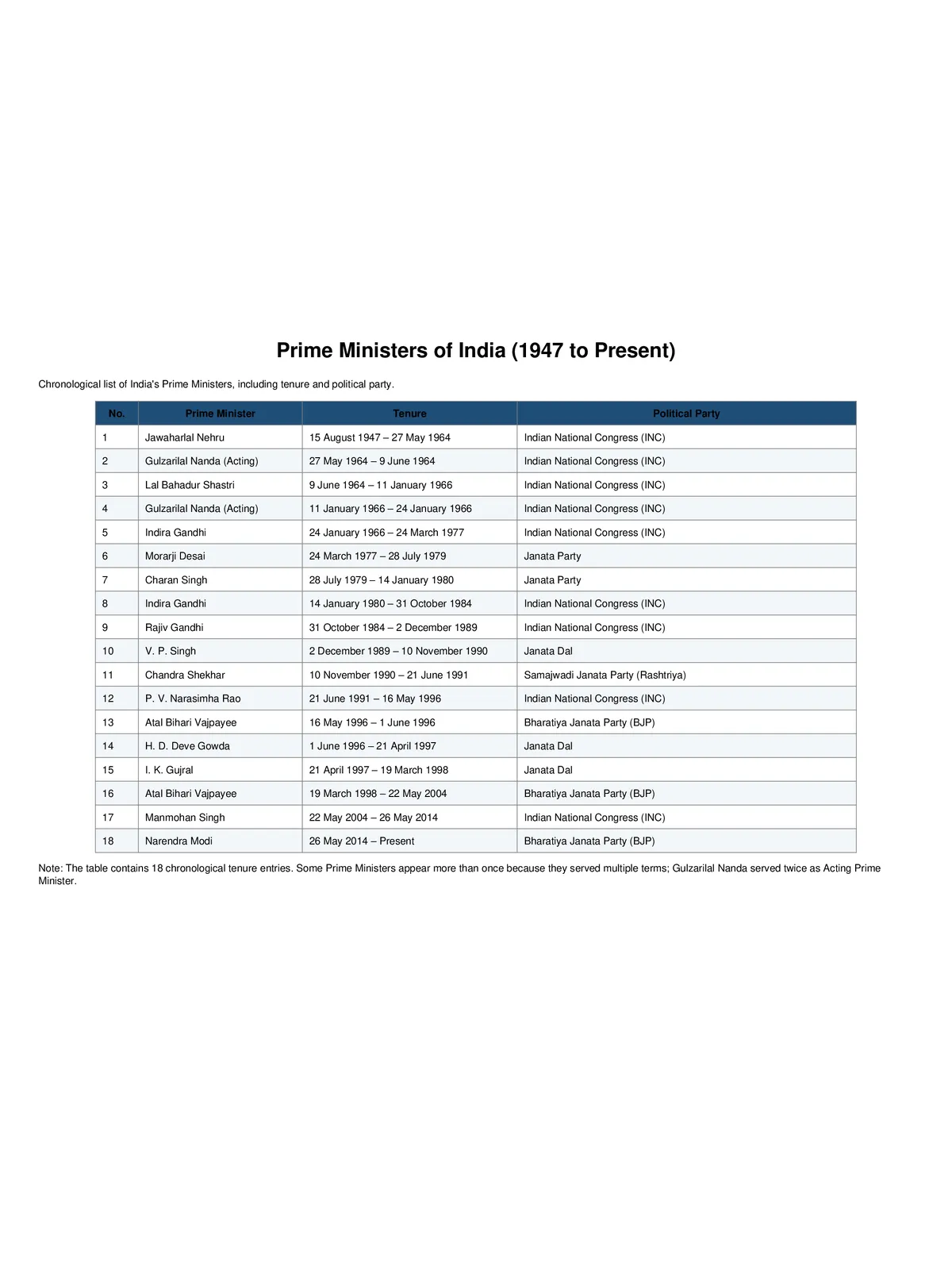
List of Prime Minister of India - Summary
Prime Minister of India is the head of government and the chief executive of the Republic of India. In India’s parliamentary democratic system established under the Constitution, executive authority is formally vested in the President of India, but in practice, real executive authority (the de facto head of government) is exercised by the Prime Minister along with the Union Council of Ministers.
According to Article 75 of the Constitution of India, the Prime Minister is appointed by the President of India. Since India gained independence on 15 August 1947, 14 distinguished individuals have served as full-time Prime Ministers of India, with Gulzarilal Nanda serving twice as acting Prime Minister. Below is the complete, chronological list of Prime Ministers of India from 1947 to 2026, along with their tenure, political parties, and key milestones.
Prime Minister of India – Highlights
| Particulars | Details |
| Constitutional Office | Head of the Government of India (Council of Ministers) |
| Appointing Authority | President of India (under Article 75) |
| First Prime Minister | Pt. Jawaharlal Nehru (15 August 1947) |
| Current Prime Minister | Narendra Modi (Serving 3rd Term, 2014 – Present) |
| Official Residence | 7, Lok Kalyan Marg (formerly 7, Race Course Road), New Delhi |
| Term of Office | At the pleasure of the President (usually 5 years coinciding with Lok Sabha term) |
| Minimum Age to Become PM | 25 Years (Lok Sabha Member) / 30 Years (Rajya Sabha Member) |
| Longest-Serving Prime Minister | Pt. Jawaharlal Nehru (16 years, 286 days) |
| Shortest Tenure | Atal Bihari Vajpayee (16 days in first term, 1996) |
| First Female Prime Minister | Indira Gandhi (1966 – 1977, 1980 – 1984) |
| Relevant Constitutional Articles | Articles 74, 75, 78 |
Complete List of Prime Ministers of India (1947 – 2026)
| S.No. | Name of Prime Minister | Term of Office | Tenure | Political Party |
| 1 | Jawaharlal Nehru | 15 August 1947 – 27 May 1964 | 16 years, 286 days | Indian National Congress |
| – | Gulzarilal Nanda (Acting) | 27 May 1964 – 9 June 1964 | 13 days | Indian National Congress |
| 2 | Lal Bahadur Shastri | 9 June 1964 – 11 January 1966 | 1 year, 216 days | Indian National Congress |
| – | Gulzarilal Nanda (Acting) | 11 January 1966 – 24 January 1966 | 13 days | Indian National Congress |
| 3 | Indira Gandhi | 24 January 1966 – 24 March 1977 | 11 years, 59 days | Indian National Congress |
| 4 | Morarji Desai | 24 March 1977 – 28 July 1979 | 2 years, 126 days | Janata Party |
| 5 | Charan Singh | 28 July 1979 – 14 January 1980 | 170 days | Janata Party (Secular) |
| (3) | Indira Gandhi | 14 January 1980 – 31 October 1984 | 4 years, 291 days | Indian National Congress (I) |
| 6 | Rajiv Gandhi | 31 October 1984 – 2 December 1989 | 5 years, 32 days | Indian National Congress (I) |
| 7 | Vishwanath Pratap Singh | 2 December 1989 – 10 November 1990 | 343 days | Janata Dal (National Front) |
| 8 | Chandra Shekhar | 10 November 1990 – 21 June 1991 | 223 days | Samajwadi Janata Party |
| 9 | P. V. Narasimha Rao | 21 June 1991 – 16 May 1996 | 4 years, 330 days | Indian National Congress |
| 10 | Atal Bihari Vajpayee | 16 May 1996 – 1 June 1996 | 16 days | Bharatiya Janata Party |
| 11 | H. D. Deve Gowda | 1 June 1996 – 21 April 1997 | 324 days | Janata Dal (United Front) |
| 12 | Inder Kumar Gujral | 21 April 1997 – 19 March 1998 | 332 days | Janata Dal (United Front) |
| (10) | Atal Bihari Vajpayee | 19 March 1998 – 22 May 2004 | 6 years, 64 days | Bharatiya Janata Party (NDA) |
| 13 | Dr. Manmohan Singh | 22 May 2004 – 26 May 2014 | 10 years, 4 days | Indian National Congress (UPA) |
| 14 | Narendra Modi | 26 May 2014 – Incumbent | Serving 3rd Term | Bharatiya Janata Party (NDA) |
Key Facts About Prime Ministers of India
- First & Longest-Serving PM: Jawaharlal Nehru served as the first Prime Minister of Independent India for 16 years and 286 days until his death in 1964.
- First Woman Prime Minister: Indira Gandhi became India’s first and only female Prime Minister to date, serving from 1966 to 1977 and again from 1980 to 1984.
- First Non-Congress PM: Morarji Desai formed the first non-Congress government in 1977 under the Janata Party. He was also the oldest person to assume the office of Prime Minister at age 81.
- Youngest Prime Minister: Rajiv Gandhi assumed office at the age of 40 in 1984 following the assassination of Indira Gandhi.
- Father of Economic Reforms: P. V. Narasimha Rao, along with then Finance Minister Dr. Manmohan Singh, spearheaded landmark economic reforms (Liberalization, Privatization, and Globalization – LPG) in 1991. He was also the first PM from Southern India.
- Only PM Who Did Not Face Parliament: Chaudhary Charan Singh never faced the Lok Sabha during his tenure due to the withdrawal of support by the Congress party before the Parliament session commenced.
- First PM to Complete Full Term as Non-Congress Leader: Atal Bihari Vajpayee was the first non-Congress Prime Minister to complete a full five-year term (1999-2004).
- First Sikh Prime Minister: Dr. Manmohan Singh served two consecutive five-year terms from 2004 to 2014 under the United Progressive Alliance (UPA).
- Longest-Serving Non-Congress PM: Narendra Modi is the fourth-longest-serving Prime Minister overall and the longest-serving non-Congress Prime Minister in Indian history, winning consecutive terms in 2014, 2019, and 2024.
Constitutional Provisions Governing the Prime Minister
- Article 74: Provides that there shall be a Council of Ministers with the Prime Minister at the head to aid and advise the President in the exercise of their functions.
- Article 75: Mentions that the Prime Minister shall be appointed by the President, and other ministers shall be appointed by the President on the advice of the Prime Minister. The Council of Ministers is collectively responsible to the Lok Sabha.
- Article 78: Defines the duties of the Prime Minister in communicating decisions of the Council of Ministers to the President and furnishing information relating to the administration of the Union.
Download List of Prime Ministers of India PDF: Candidates preparing for UPSC, SSC, Banking, State PSCs, and railway exams can download the complete list and study notes using the PDF download button below.
List of Prime Minister of India PDF Download
RELATED PDF FILES-
 List of UGC Approved Journals
-
 Comprehensive A to Z List of Computer Parts and Their Full Forms
-
 List of Holidays 2026 Jammu and Kashmir
-
 Voter List of Tripura 2003
-
 List of Holidays 2026 Punjab
-
 List of Exempted Goods Under GST
-
 PMAY List of Cities (State-Wise)
-
 List of Government Agriculture Colleges in AP