CLAT Syllabus 2026 - Summary
Consortium of National Law Universities (Consortium of NLUs) has outlined the detailed CLAT Syllabus 2026 and updated examination pattern for the Common Law Admission Test. CLAT is the premier national-level law entrance examination conducted for candidates aspiring to secure admission into five-year integrated undergraduate (UG) law programmes-such as B.A. LL.B. (Hons), B.B.A. LL.B. (Hons), and B.Com. LL.B. (Hons)-and one-year postgraduate (PG) LL.M. programmes offered by 24 participating National Law Universities across India.
The updated CLAT examination places strong emphasis on reading comprehension, critical reasoning, and analytical skills through passage-based multiple-choice questions. Candidates preparing for the examination can review the complete section-wise syllabus, marks distribution, question format, and download the official CLAT 2026 syllabus PDF below.
CLAT 2026 Exam Overview – Highlights
| Particulars | Details |
| Exam Name | Common Law Admission Test (CLAT) 2026 |
| Conducting Body | Consortium of National Law Universities (NLUs) |
| Exam Level | National Level Law Entrance Examination |
| Courses Offered | 5-Year Integrated Law (UG) & 1-Year LL.M. (PG) |
| Exam Mode | Offline (Pen-and-Paper / OMR Sheet Based Test) |
| Exam Duration | 2 Hours (120 Minutes) |
| Total Questions | 120 Questions (Reduced Pattern) |
| Total Marks | 120 Marks |
| Question Type | Comprehension Passage-Based Multiple Choice Questions (MCQs) |
| Marking Scheme | +1 Mark for each correct answer; -0.25 Mark for each wrong answer |
| Language / Medium | English |
| Participating NLUs | 24 National Law Universities + 60+ Affiliate Law Schools |
| Official Website | consortiumofnlus.ac.in |
CLAT UG 2026 Section-Wise Weightage & Marks Distribution
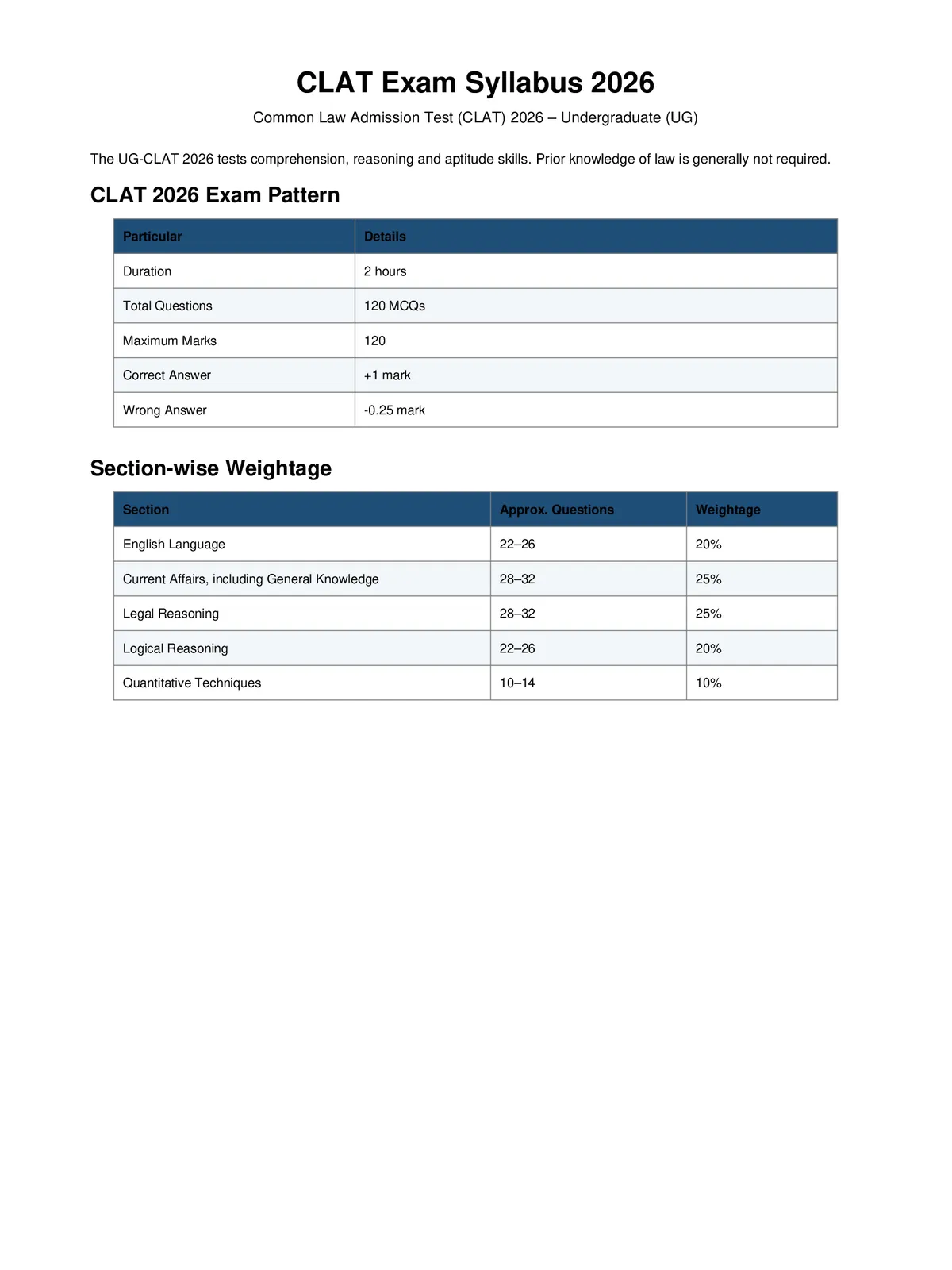
The CLAT UG question paper consists of 120 passage-based multiple-choice questions distributed across five core sections as detailed below:
| Section | Number of Questions | Weightage (%) | Total Marks |
| English Language | 22 – 26 Questions | ~20% | 22 – 26 Marks |
| Current Affairs Including General Knowledge | 28 – 32 Questions | ~25% | 28 – 32 Marks |
| Legal Reasoning | 28 – 32 Questions | ~25% | 28 – 32 Marks |
| Logical Reasoning | 22 – 26 Questions | ~20% | 22 – 26 Marks |
| Quantitative Techniques | 10 – 14 Questions | ~10% | 10 – 14 Marks |
| Total | 120 Questions | 100% | 120 Marks |
Detailed Section-Wise CLAT UG Syllabus 2026
1. English Language
In this section, candidates will be provided passages of about 450 words each derived from contemporary or historically significant fiction and non-fiction writing. Each passage will be followed by a series of multiple-choice questions designed to assess comprehension and language proficiency:
- Reading Comprehension: Reading and understanding the central theme, author’s viewpoint, and main arguments in the passage.
- Drawing Inferences & Conclusions: Deriving logical inferences and evaluating perspectives discussed in the text.
- Summarizing & Paraphrasing: Identifying key points and summarizing passage arguments.
- Vocabulary in Context: Synonyms, antonyms, idiomatic expressions, tone of the author, and contextual word meanings.
2. Current Affairs Including General Knowledge
This section features passages of up to 450 words drawn from journalistic sources, news reports, and non-fiction articles. The questions test awareness of important current events and static general knowledge connected to the topics:
- National & International Affairs: Significant events of national and global importance occurring over the past 12 months.
- Contemporary Events: Major summits, treaties, geopolitical developments, international organizations (UN, G20, BRICS, WHO), and bilateral relations.
- Arts & Culture: Indian heritage, classical arts, literature awards, book releases, and cultural festivals.
- Historical Events of Continuing Significance: Important constitutional and modern Indian historical events linked to current happenings.
- Science, Technology & Environment: Climate summits, scientific breakthroughs, space exploration (ISRO/NASA missions), and government policies.
3. Legal Reasoning
Candidates will be presented with passages of about 450 words discussing legal scenarios, landmark court rulings, philosophical moral dilemmas, or public policy issues. Prior formal knowledge of law is not mandatory; all relevant legal principles and rules are outlined directly within the passage:
- Identifying Legal Rules & Principles: Extracting governing legal principles provided in the passage text.
- Application of Principles to Facts: Applying the identified principles to novel factual situations to determine legal liability or outcome.
- Understanding Key Legal Domains: Constitutional Law (Fundamental Rights, Preamble, Directive Principles), Law of Torts (Negligence, Strict Liability, Defamation), Law of Contracts (Offer, Acceptance, Consideration, Breach), Criminal Law (IPC/BNS concepts, culpable homicide, theft, general exceptions), and Intellectual Property Rights.
4. Logical Reasoning
This section consists of short passages of about 300 words each followed by questions testing analytical and critical thinking:
- Identifying Arguments & Premises: Recognizing premises, conclusions, and underlying assumptions in an argument.
- Strengthening & Weakening Arguments: Assessing how new information affects the validity of an author’s argument.
- Analogies & Relationships: Identifying structural similarities, parallels, and analogies across situations.
- Detecting Logical Fallacies: Identifying flaws in reasoning, inconsistencies, contradictions, and circular arguments.
5. Quantitative Techniques (Mathematics)
Unlike conventional objective maths exams, this section includes short passages, caselets, graphical representations, or tabular data containing numerical facts, followed by objective questions based on Class 10 standard mathematics:
- Data Interpretation (DI): Caselets, tables, pie charts, bar charts, and line graphs.
- Ratios & Proportions
- Percentages & Averages
- Profit, Loss & Discounts
- Simple & Compound Interest
- Time, Speed, Distance & Work
- Basic Mensuration & Estimation
CLAT PG Syllabus 2026 (LL.M.)
The post-graduate CLAT PG paper consists of 120 objective questions testing comprehension of mandatory undergraduate law subjects. The syllabus covers:
- Constitutional Law (Significant weightage)
- Jurisprudence & Legal Theory
- Administrative Law
- Law of Contract & Specific Relief
- Law of Torts & Consumer Protection
- Family Law (Hindu Law & Muslim Law)
- Criminal Law (IPC/BNS & CrPC/BNSS)
- Property Law
- Company Law & Corporate Governance
- Public International Law & Human Rights
- Environmental Law & Labour Laws
CLAT 2026 Eligibility Criteria
- For CLAT UG: Candidates must have passed the 10+2 / Intermediate examination or equivalent with a minimum of 45% marks (for General / OBC / PwD / NRI categories) and 40% marks (for SC and ST categories). Candidates appearing for the 10+2 exam are also eligible to apply. There is no upper age limit for CLAT UG.
- For CLAT PG: Candidates must hold an LL.B. Degree or an equivalent examination with a minimum of 50% marks (for General / OBC / PwD) and 45% marks (for SC / ST). Final-year law students are also eligible to apply. There is no upper age limit for CLAT PG.
Recommended Books & Preparation Strategy
- Improve Reading Speed: Since the entire 120-question paper is passage-based, read editorials daily from reputed national dailies like The Hindu or The Indian Express.
- Practice Legal Case Scenarios: Solve passages focusing on legal principles, landmark Supreme Court verdicts, and constitution bench judgments.
- Daily Current Affairs Revision: Prepare comprehensive monthly current affairs notes covering international relations, appointments, awards, and national bills/laws.
- Solve Previous Years’ Question Papers: Regularly solve official CLAT sample papers and mock tests under timed 2-hour conditions to master time allocation and minimize negative marking (-0.25).
Download CLAT Syllabus 2026 PDF: Candidates can download the official Consortium of NLUs CLAT UG and PG Syllabus PDF and sample question paper using the link given below.