Draft National Electricity Policy (NEP) 2026 - Summary
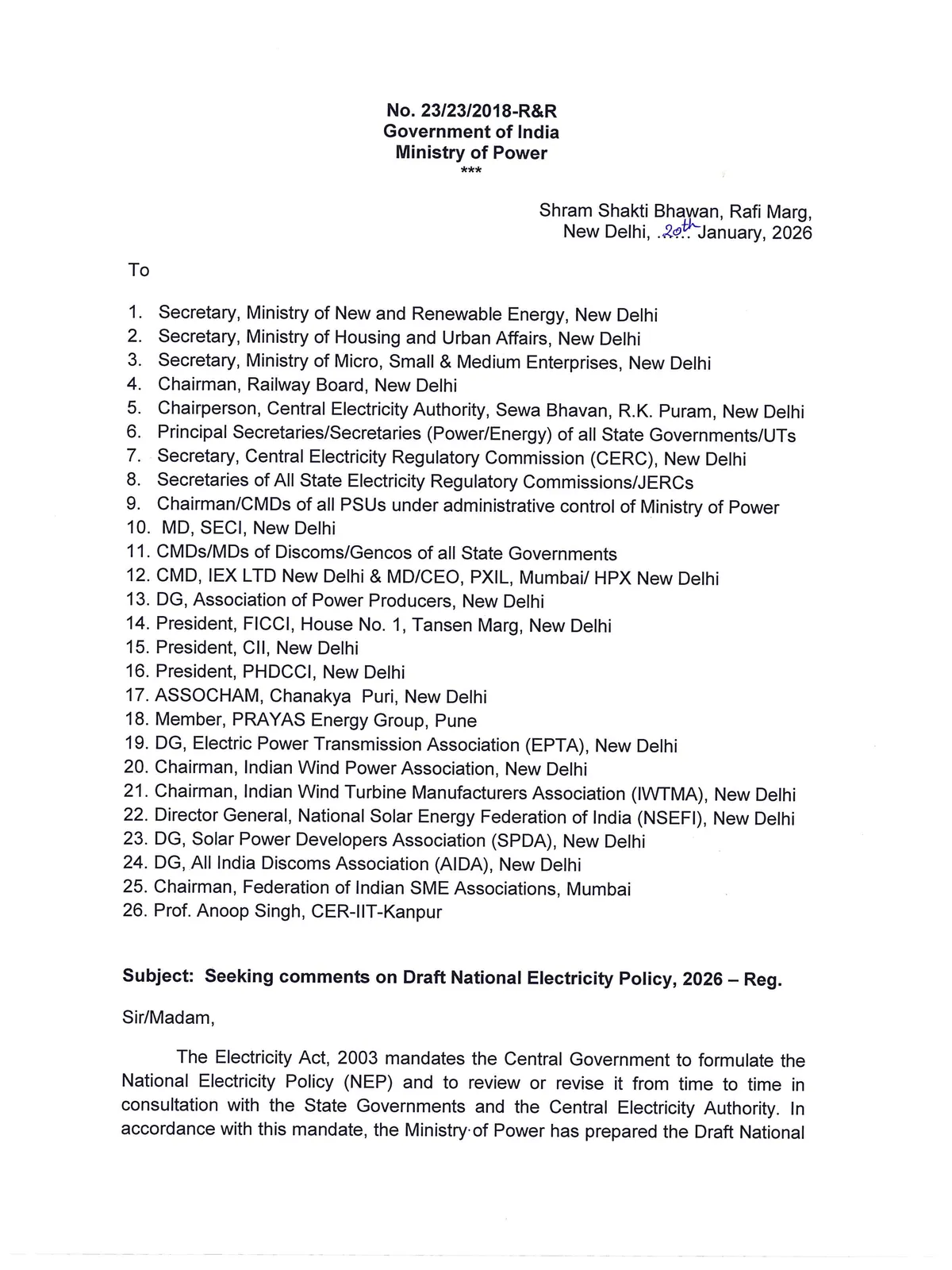
The Ministry of Power announced the release of a new “Draft National Electricity Policy (NEP) 2026”. The Draft NEP 2026 aims to transform the power sector for meeting the vision of Viksit Bharat @2047. The policy, once finalised, intends to replace the existing NEP which was notified in 2005.
The first National Electricity Policy, notified in February 2005, addressed fundamental challenges of the power sector, including demand–supply deficits, limited access to electricity, and inadequate infrastructure. Since then, India’s power sector has witnessed transformational progress. Installed generation capacity has increased fourfold with significant private sector participation; universal electrification was achieved by March 2021; a unified national grid became operational in December 2013; and per capita electricity consumption reached 1,460 kWh in 2024–25.
Draft National Electricity Policy (NEP) 2026 – Highlights
Resource Adequacy (RA)
DISCOMs and SLDCs to prepare decentralized RA plans at utility and state levels.
Central Electricity Authority (CEA) to prepare a national-level resource adequacy plan.
Financial Viability & Economic Competitiveness
Automatic annual tariff revision linked to a suitable index if no tariff order is issued.
Gradual recovery of fixed costs through demand charges to reduce cross-subsidies.
Removal of cross-subsidies and surcharges for manufacturing, railways, and metro rail.
Distribution licensees may be exempted from Universal Service Obligation for consumers with ≥1 MW contracted load.
Strengthened dispute resolution mechanisms for faster and cost-effective resolution.
Renewable Energy Generation & Storage
RE capacity addition through market-based routes and captive power plants.
Distribution licensees to install storage for small consumers; bulk consumers to install their own.
Peer-to-peer (P2P) and aggregator-based trading of surplus DRE and stored energy.
Scheduling and deviation parity between RE and conventional power by 2030.
Market-driven storage deployment, promotion of BESS manufacturing, and VGF support for BESS and pumped storage.
Thermal Power Generation
Integration of storage and repurposing of old thermal units for grid support.
Utilization of thermal plant steam for district cooling and industrial applications.
Nuclear Power
Adoption of advanced nuclear technologies, modular and small reactors.
Commercial and industrial use of nuclear power to achieve 100 GW capacity by 2047.
Hydropower
Fast-tracked development of storage-based hydro projects.
Enhanced role in flood control, irrigation, water security, and energy storage.
Power Markets
Strong market monitoring and surveillance framework to prevent manipulation and market dominance.
Transmission
Adoption of advanced technologies and fair compensation to resolve RoW issues.
Transmission tariff parity with conventional power for new RE projects by 2030.
Utilization-based allocation of transmission connectivity to prevent hoarding.
Distribution
Target of single-digit AT&C losses.
Shared distribution networks to promote competition and efficiency.
Establishment of Distribution System Operator (DSO).
N-1 redundancy at distribution transformer level in cities with population above 10 lakh by 2032.
Undergrounding of distribution networks in congested urban areas.
Grid Operations
Functional unbundling of STUs and independent management of SLDC operations.
Alignment of State Grid Codes with the Indian Electricity Grid Code.
Cybersecurity
Robust cybersecurity framework for the power sector.
Mandatory domestic storage of power sector data for data sovereignty.
Data Sharing
Structured sharing of operational and market data.
Real-time visibility of Distributed Energy Resources for DISCOMs and SLDCs.
Technology & Skill Development
Transition to indigenously developed SCADA systems by 2030.
Development of domestic software solutions for critical power system applications.