APPSC Group 2 Syllabus 2026 - Summary
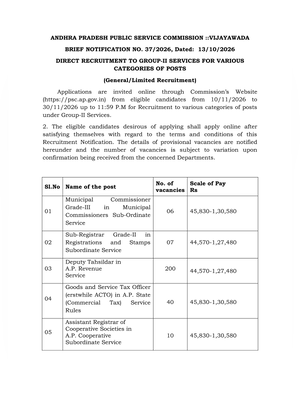
APPSC Group 2 syllabus PDF is the official examination curriculum issued by the Andhra Pradesh Public Service Commission for Group-II Services recruitment. Candidates preparing for executive and non-executive posts can review the latest paper pattern and subject-wise syllabus for the preliminary screening test and main examination.
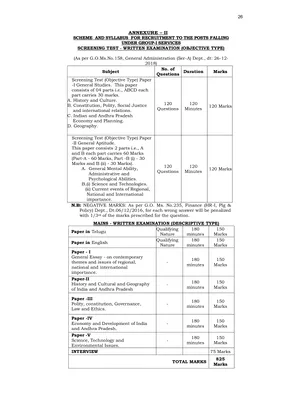
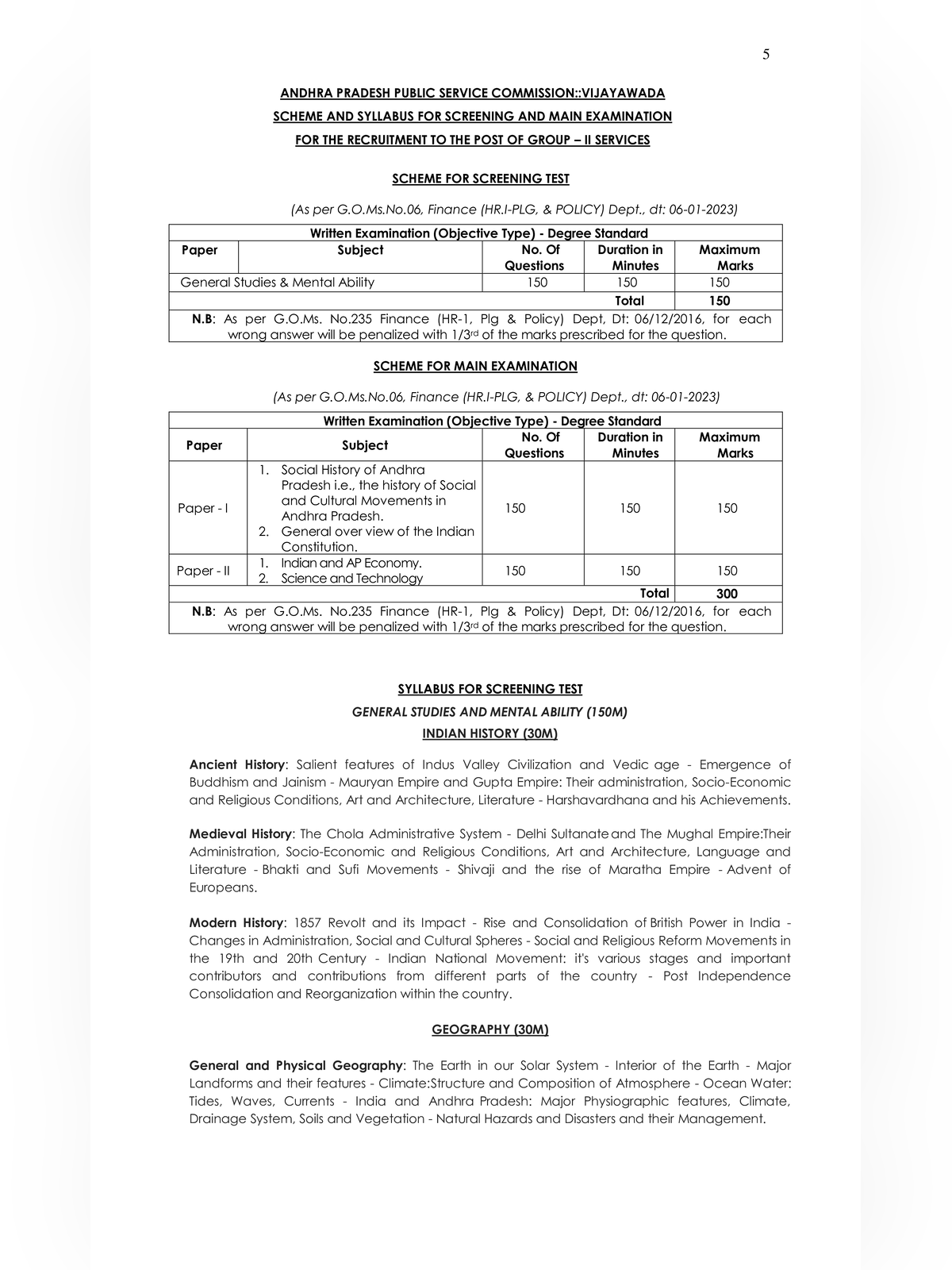
The recruitment process includes a preliminary screening test of 150 marks, a main examination of 300 marks, and a qualifying Computer Proficiency Test (CPT) of 100 marks.
APPSC Group 2 Exam Pattern 2026
The preliminary screening test contains five sections with 150 objective questions to solve in 150 minutes. Each incorrect response attracts a negative mark deduction of one-third (0.33) marks.
| Exam Stage | Paper and Subjects | Questions | Marks | Duration |
|---|---|---|---|---|
| Screening Test | General Studies and Mental Ability (History, Geography, Indian Society, Current Affairs, Mental Ability) | 150 | 150 | 150 minutes |
| Mains Paper 1 | Social History of Andhra Pradesh and General Overview of the Indian Constitution | 150 | 150 | 150 minutes |
| Mains Paper 2 | Indian and AP Economy, Science and Technology | 150 | 150 | 150 minutes |
APPSC Group 2 Syllabus 2026: Screening Test/Prelims
The Screening Test syllabus covers five major areas: Indian History, Geography, Indian Society, Current Affairs and Mental Ability. The subject-wise topics are listed below.
| Subject & Marks | Topics |
|---|---|
| INDIAN HISTORY (30 Marks) | |
| Ancient History | • Salient features of Indus Valley Civilization and Vedic Age • Emergence of Buddhism and Jainism • Mauryan Empire and Gupta Empire: Administration, Socio-Economic and Religious Conditions, Art and Architecture, Literature • Harshavardhana and his Achievements |
| Medieval History | • The Chola Administrative System • Delhi Sultanate and The Mughal Empire: Administration, Socio-Economic and Religious Conditions, Art and Architecture, Language and Literature • Bhakti and Sufi Movements • Shivaji and the rise of Maratha Empire • Advent of Europeans |
| Modern History | • 1857 Revolt and its Impact • Rise and Consolidation of British Power in India • Changes in Administration, Social and Cultural Spheres • Social and Religious Reform Movements in the 19th and 20th Century • Indian National Movement: Various stages, important contributors and contributions from different parts of the country • Post Independence Consolidation and Reorganization within the country |
| GEOGRAPHY (30 Marks) | |
| General and Physical Geography | • The Earth in our Solar System • Interior of the Earth • Major Landforms and their features • Climate: Structure and Composition of Atmosphere • Ocean Water: Tides, Waves, Currents • India and Andhra Pradesh: Major Physiographic features, Climate, Drainage System, Soils and Vegetation • Natural Hazards and Disasters and their Management |
| Economic Geography of India and AP | • Natural resources and their distribution • Agriculture and Agro based Activities • Distribution of Major Industries and Major Industrial Regions • Transport, Communication, Tourism and Trade |
| Human Geography of India and AP | • Human Development • Demographics • Urbanization and Migration • Racial, Tribal, Religious and Linguistic groups |
| INDIAN SOCIETY (30 Marks) | |
| Structure of Indian Society | • Family, Marriage, Kinship, Caste, Tribe, Ethnicity, Religion and Women |
| Social Issues | • Casteism, Communalism and Regionalisation • Crime against Women, Child Abuse and Child Labour • Youth Unrest and Agitation |
| Welfare Mechanism | • Public Policies and Welfare Programmes • Constitutional and Statutory Provisions for Schedule Castes, Schedule Tribes, Minorities, BCs, Women, Disabled and Children |
| CURRENT AFFAIRS (30 Marks) | |
| Major Current Events and Issues pertaining to | • International • National • State of Andhra Pradesh |
| MENTAL ABILITY (30 Marks) | |
| Logical Reasoning (Deductive, Inductive, Abductive) | • Statement and Assumptions • Statement and Argument • Statement and Conclusion • Statement and Courses of Action |
| Mental Ability | • Number Series • Letter Series • Odd Man out • Coding – Decoding • Problems relating to Relations • Shapes and their Sub Sections |
| Basic Numeracy | • Number System • Order of Magnitude • Averages • Ratio and Proportion • Percentage • Simple and Compound Interest • Time and Work • Time and Distance |
| Data Analysis | • Tables • Bar diagram • Line graph • Pie chart |
APPSC Group 2 Mains Syllabus 2026
The APPSC Group 2 Mains Examination consists of two papers, each carrying 150 marks. The syllabus covers Andhra Pradesh history, Indian Constitution, Indian and Andhra Pradesh economy, and Science and Technology.
Paper I: Social and Cultural History of Andhra Pradesh & Indian Constitution
Section A: Social and Cultural History of Andhra Pradesh (75 Marks)
| No. | Topics | Detailed Syllabus |
|---|---|---|
| 1 | Prehistoric Cultures and Early Dynasties | Prehistoric cultures, Satavahanas, Ikshvakus, Vishnukundins, Eastern Chalukyas of Vengi and Andhra Cholas. Their social, economic, religious, literary, artistic and architectural contributions. |
| 2 | Medieval Andhra History | Major and minor dynasties ruling Andhra between the 11th and 16th centuries. Development of Telugu language, literature, art and architecture. |
| 3 | Advent of Europeans and British Rule | European trading centres, Andhra under the East India Company, Revolt of 1857 and its impact, establishment of British rule. |
| 4 | Social and Nationalist Movements | Socio-cultural awakening, Justice Party, Self-Respect Movement, nationalist movement in Andhra, socialist and communist movements, anti-zamindari and Kisan movements, revolutionary literature and women’s participation. |
| 5 | Andhra Movement | Origin and growth of the Andhra Movement, Andhra Mahasabhas, prominent leaders, role of newspapers and library movement, formation of Andhra State in 1953. |
| 6 | Formation of Andhra Pradesh | Visalandhra Mahasabha, States Reorganisation Commission, Gentlemen’s Agreement and major social and cultural developments from 1956 to 2014. |
Section B: Indian Constitution (75 Marks)
| No. | Topics | Detailed Syllabus |
|---|---|---|
| 1 | Constitutional Framework | Constitutional development, salient features, Preamble, Fundamental Rights, Directive Principles of State Policy, Fundamental Duties, constitutional amendments and Basic Structure Doctrine. |
| 2 | Structure of Government | Legislature, Executive, Judiciary, unicameral and bicameral legislatures, judicial review and judicial activism. |
| 3 | Centre-State Relations | Distribution of legislative, administrative, financial and executive powers between the Union and States. |
| 4 | Constitutional and Statutory Bodies | Powers and functions of constitutional bodies, Human Rights Commission, Right to Information (RTI), Lokpal and Lokayukta. |
| 5 | Federalism and Political System | Unitary and federal features, Rajamannar Committee, Sarkaria Commission, M.M. Punchhi Commission, political parties, party recognition, elections, electoral reforms and Anti-Defection Law. |
| 6 | Decentralisation and Local Governance | Community Development Programme, Balwant Rai Mehta Committee, Ashok Mehta Committee and 73rd and 74th Constitutional Amendment Acts. |
Paper II: Indian and Andhra Pradesh Economy & Science and Technology
Section A: Indian and Andhra Pradesh Economy (75 Marks)
| No. | Topics | Detailed Syllabus |
|---|---|---|
| 1 | Indian Economy, Planning and Policy | National income, measurement of national income, occupational structure, sectoral distribution, economic growth, economic development, planning strategies, economic reforms of 1991, financial decentralisation and NITI Aayog. |
| 2 | Money, Banking and Public Finance | Money supply, RBI functions, monetary policy, credit control, banking reforms, inflation, fiscal policy, deficit financing, taxation, GST, Union Budget, balance of payments and Foreign Direct Investment (FDI). |
| 3 | Agriculture, Industry and Services | Agricultural production and productivity, cropping patterns, agricultural finance, marketing, MSP, procurement, industrial development, New Industrial Policy of 1991, disinvestment, Ease of Doing Business, industrial sickness and contribution of services and IT/ITES sectors. |
| 4 | Andhra Pradesh Economy and Public Finance | Structure and growth of state economy, Gross State Domestic Product (GSDP), per capita income, tax and non-tax revenue, public expenditure, state debt, interest payments, central assistance, externally assisted projects and state budget. |
| 5 | Agriculture and Allied Sectors in Andhra Pradesh | Agricultural production, rural credit cooperatives, agricultural marketing, horticulture, animal husbandry, fisheries, forestry and relevant government schemes and programmes. |
| 6 | Industries and Services in Andhra Pradesh | Industrial development policies, single-window mechanisms, industrial incentives, MSMEs, industrial corridors, IT, electronics, communications and state IT policy. |
Section B: Science and Technology (75 Marks)
| No. | Topics | Detailed Syllabus |
|---|---|---|
| 1 | Science and Technology Policies | National Science and Technology Policy, innovation policy, emerging technologies, national missions and technology applications. |
| 2 | Space, Defence and ICT | Indian launch vehicles, satellite launches, space missions, DRDO, missile development programmes, Digital India, e-governance, cybersecurity, nuclear reactors and radioisotope applications. |
| 3 | Energy Management | India’s energy capacity and demand, National Energy Policy, biofuel policy, Bharat Stage emission standards, renewable and non-renewable energy sources and recent renewable energy initiatives. |
| 4 | Ecosystem and Biodiversity | Ecology, ecosystem components, biodiversity hotspots, biodiversity loss and conservation, CITES, endangered species, biosphere reserves, wildlife conservation projects and environmental legislation. |
| 5 | Waste Management and Pollution Control | Solid waste classification and disposal, types and sources of pollution, pollution control measures, transgenic organisms and environmental regulation, eco-friendly agricultural technologies and bioremediation. |
| 6 | Environment and Climate Change | Global warming, climate change, acid rain, ozone depletion, ocean acidification, international environmental conventions, India’s role in climate initiatives and Sustainable Development Goals (SDGs). |
| 7 | Health and Public Health Initiatives | Disease burden, epidemics and pandemics, healthcare delivery, health outcomes and recent public health programmes in India. |
Computer proficiency test
Candidates shortlisted after the main examination must pass the 60-minute practical Computer Proficiency Test of 100 marks. The test checks practical knowledge in office automation tools, spreadsheets, presentations, and internet usage on psc.ap.gov.in.
Candidates can also read the APPSC Group 2 notification for vacancy details and eligibility rules, or review the APPSC Group 1 syllabus for higher state service exams.