TG TET Syllabus 2027 - Summary
TG TET syllabus 2027 is the official curriculum and test pattern issued by the Department of School Education, Government of Telangana, for the Telangana Teacher Eligibility Test. It sets the exam structure, subject-wise topics, and mark distribution for Paper 1 (classes 1 to 5) and Paper 2 (classes 6 to 8).
Both papers consist of 150 multiple-choice questions for 150 marks, with an exam duration of 2 hours and 30 minutes. There is no negative marking for incorrect answers. Candidates preparing for teacher recruitment can also check the CTET syllabus for central school eligibility.
TG TET Paper 1 syllabus and exam pattern
Paper 1 tests candidates who plan to teach primary classes across five compulsory sections:
| Subject | Questions | Marks | Key topics |
|---|---|---|---|
| Child Development and Pedagogy | 30 | 30 | Child growth stages, learning theories, inclusive education, and classroom evaluation methods |
| Language I (Telugu / Urdu / Hindi / others) | 30 | 30 | Reading comprehension, vocabulary, grammar rules, and mother tongue pedagogy |
| Language II (English) | 30 | 30 | Comprehension, parts of speech, tenses, sentence structure, and English teaching methods |
| Mathematics | 30 | 30 | Number system, fractions, arithmetic, basic geometry, data handling, and math pedagogy |
| Environmental Studies | 30 | 30 | Family, plants, animals, water, shelter, Telangana heritage, and environmental science basics |
| Total | 150 | 150 | Standard A4 printable syllabus covers Telangana State Board classes 1 to 5 textbooks |
TG TET Paper 2 syllabus and exam pattern
Paper 2 is designed for candidates seeking teaching eligibility for upper primary classes 6 to 8:
| Subject | Questions | Marks | Key topics |
|---|---|---|---|
| Child Development and Pedagogy | 30 | 30 | Adolescent psychology, cognitive development, learning difficulties, and instructional planning |
| Language I | 30 | 30 | Advanced reading comprehension, literary forms, grammar, and language teaching methods |
| Language II (English) | 30 | 30 | Grammar concepts, unseen passages, vocabulary usage, and English language pedagogy |
| Mathematics and Science OR Social Studies | 60 | 60 | Algebra, geometry, physics, biology, or Indian history, geography, civics, and pedagogy |
| Total | 150 | 150 | Topics follow Telangana State Board classes 6 to 8 syllabus with difficulty up to class 10 |
TS TET Syllabus 2027 for Paper 1
The TGTET Syllabus contains the chapters which are to be studied for the examination. See below the syllabus of Telangana TET Paper I and II subject wise.
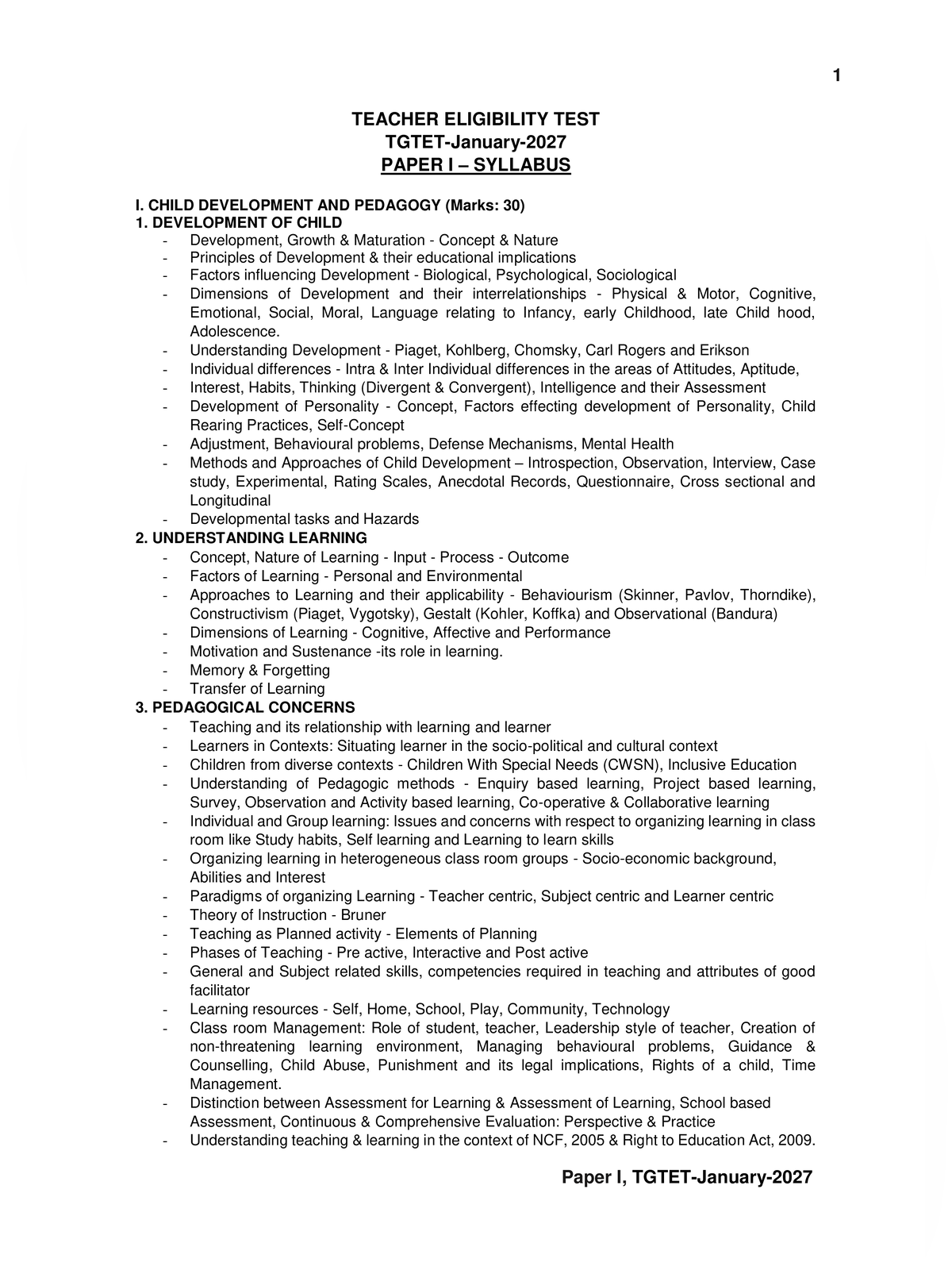
TSTET Child Development and Pedagogy Syllabus
Development of Child
- Development, Growth & Maturation – Concept & Nature
- Principles of Development & their Educational Implications
- Factors Influencing Development – Biological, Psychological, Sociological
- Dimensions of Development and their interrelationships – Physical & Motor, Cognitive, Emotional, Social, Moral, and Language relating to Infancy, early Childhood, late Childhood, and Adolescence.
- Understanding Development – Piaget, Kohlberg, Chomsky, Carl Rogers and Erikson
- Individual differences – Intra & Inter Individual differences in the areas of Attitudes, Aptitude, Interest, Habits, Thinking (Divergent & Convergent), Intelligence and their Assessment
- Development of Personality – Concept, Factors affecting the development of Personality, Child Rearing Practices, Self-Concept
- Adjustment, Behavioral problems, Defense Mechanisms, Mental Health
- Methods and Approaches of Child Development – Introspection, Observation, Interview, Case study, Experimental, Rating Scales, Anecdotal Records, Questionnaire, Cross-sectional and Longitudinal
- Developmental Tasks and Hazards
Understanding Learning
- Concept, Nature of Learning – Input – Process – Outcome
- Factors of Learning – Personal and Environmental
- Approaches to Learning and their applicability – Behaviorism (Skinner, Pavlov, Thorndike), Constructivism (Piaget, Vygotsky), Gestalt (Kohler, Koffka) and Observational (Bandura)
- Dimensions of Learning – Cognitive, Affective and Performance
- Motivation and Sustenance -its role in learning.
- Memory & Forgetting
- Transfer of Learning
Pedagogical Concerns
- Teaching and its Relationship with Learning and Learners
- Learners in Contexts: Situating learners in the socio-political and cultural context
- Children from diverse contexts – Children With Special Needs (CWSN), Inclusive Education
- Understanding of Pedagogic methods – Enquiry-based learning, Project-based learning, Survey, Observation and Activity-based learning, Co-operative & Collaborative learning
- Individual and Group learning: Issues and concerns with respect to organizing learning in the classroom like Study habits, Self-learning and Learning to learn skills
- Organizing learning in heterogeneous classroom groups – Socio-economic background, Abilities and Interests
- Paradigms of organizing Learning – Teacher-centric, Subject-centric and Learner-centric
- Theory of Instruction – Bruner
- Teaching as Planned Activity – Elements of Planning
- Phases of Teaching – Pre-active, Interactive and Post-active
- General and subject-related skills, competencies required in teaching and attributes of a good facilitator
- Learning Resources – Self, Home, School, Play, Community, Technology
- Classroom Management: Role of the student, teacher, the Leadership style of the teacher, Creation of a non-threatening learning environment, Managing behaviour problems, Guidance & Counselling, Child Abuse, Punishment and its legal implications, Rights of a child, Time Management
- The distinction between Assessment for Learning & Assessment of Learning, School-based Assessment, Continuous & Comprehensive Evaluation: Perspective & Practice
- Understanding Teaching & Learning in the Context of NCF, 2005 & Right To Education Act, 2009
TSTET Paper 1 Language-I Syllabus
The TSTET Paper 1 syllabus for Language-I differs as per the languages
- Telugu
- Urdu
- Hindi
- Bengali
- Kannada
- Marathi
- Tamil
- Gujarati
TSTET Paper 1 Language-II (English) Syllabus
- Parts of speech
- Tenses
- Types of sentences
- Prepositions & articles
- Degrees of comparison
- Direct and indirect speech
- Questions and question tags
- Active & passive voice
- Phrasal verbs
- Reading comprehension
- Composition
- Vocabulary
- Meaning of idiomatic expressions
- Correction of sentences
- Sequencing of the sentences in the given paragraph
- Error identification within a sentence
Pedagogy
- Aspects of English:- (a) English language – History, nature, importance, principles of English as a second language (b) Problems of teaching/learning English
- Objectives of Teaching English
- Phonetics
- Development of Language skills:- (a) Listening, Speaking, Reading & Writing (LSRW), (b) Communicative skills
- Approaches, Methods, and Techniques of Teaching English
- Introduction, Definition, and Types of Approaches Methods and Techniques of Teaching English and Remedial Teaching
- The teaching of structures and vocabulary items
- Teaching-learning materials in English
- Lesson Planning
- Curriculum & Textbooks
- Evaluation in English language Teaching – CCE
TSTET Paper 1 Mathematics Syllabus
The TS TET syllabus for Mathematics includes
- Number System
- Fractions
- Arithmetic
- Geometry
- Measurements
- Data Applications
- Algebra
- Pedagogy
TSTET Paper 1 Environmental Studies Syllabus
The TS TET syllabus for Environmental Studies (EVS) includes
- Family
- Work & Play
- Plants and Animals
- Food
- Shelter
- Air
- Energy
- Water
- Body – Health – Cleanliness
- Mapping
- History and Culture of India
- Telangana
- Indian constitution
- Earthquakes, Floods, Fire, First Aid, 108, 104 Vehicles
- Pedagogy
TSTET Syllabus 2027 for Paper 2
The TSTET syllabus for Paper 2 comprises topics from Child Development and Pedagogy, Language-I, Language-II and Mathematics and Science or Social Studies.
TSTET Paper 2 Child Development and Pedagogy Syllabus
Development of Child
- Development, Growth & Maturation – Concept & Nature
- Principles of Development & their Educational Implications
- Factors Influencing Development – Biological, Psychological, Sociological
- Dimensions of Development and their interrelationships – Physical & Motor, Cognitive, Emotional, Social, Moral, Language relating to Infancy, early Childhood, late Childhood, and Adolescence.
- Understanding Development – Piaget, Kohlberg, Chomsky, Carl Rogers and Erikson
- Individual differences – Intra & Inter Individual differences in the areas of Attitudes, Aptitude, Interest, Habits, Thinking (Divergent & Convergent), Intelligence and their Assessment
- Development of Personality – Concept, Factors affecting the development of Personality, Child Rearing Practices, Self-Concept
- Adjustment, Behavioral problems, Defense Mechanisms, Mental Health
- Methods and Approaches of Child Development – Introspection, Observation, Interview, Case study, Experimental, Rating Scales, Anecdotal Records, Questionnaire, Cross-sectional and Longitudinal
- Developmental Tasks and Hazards
Understanding Learning
- Concept, Nature of Learning – Input – Process – Outcome
- Factors of Learning – Personal and Environmental
- Approaches to Learning and their applicability – Behaviorism (Skinner, Pavlov, Thorndike), Constructivism (Piaget, Vygotsky), Gestalt (Kohler, Koffka) and Observational (Bandura)
- Dimensions of Learning – Cognitive, Affective and Performance
- Motivation and Sustenance -its role in learning.
- Memory & Forgetting
- Transfer of Learning
Pedagogical Concerns
- Teaching and its Relationship with Learning and Learners
- Learners in Contexts: Situating learners in the socio-political and cultural context
- Children from diverse contexts – Children With Special Needs (CWSN), Inclusive Education
- Understanding of Pedagogic methods – Enquiry based learning, Project-based learning, Survey, Observation and Activity based learning, Co-operative & Collaborative learning
- Individual and Group learning: Issues and concerns with respect to organizing learning in the classroom like Study habits, Self-learning and Learning to learn skills
- Organizing learning in heterogeneous classroom groups – Socio-economic background, Abilities and Interests
- Paradigms of organizing Learning – Teacher centric, Subject centric and Learner centric
- Theory of Instruction – Bruner
- Teaching as Planned Activity – Elements of Planning
- Phases of Teaching – Pre active, Interactive and Post active
- General and Subject related skills, competencies required in teaching and attributes of a good facilitator
- Learning Resources – Self, Home, School, Play, Community, Technology
- Classroom Management: Role of the student, teacher, the Leadership style of the teacher, Creation of a non-threatening learning environment, Managing behaviour problems, Guidance & Counseling, Child Abuse, Punishment and its legal implications, Rights of a child, Time Management
- The distinction between Assessment for Learning & Assessment of Learning, School-based Assessment, Continuous & Comprehensive Evaluation: Perspective & Practice
- Understanding Teaching & Learning in the Context of NCF, 2005 & Right To Education Act, 2009
TSTET Paper 2 Language-I Syllabus
TSTET Paper 2 syllabus for Language-I differs for
- Telugu
- Urdu
- Hindi
- Kannada
- Marathi
- Tamil
- Gujarati
TSTET Paper 2 Language-II English Syllabus
- Parts of speech
- Tenses
- Types of sentences
- Prepositions & articles
- Degrees of comparison
- Direct and indirect speech
- Questions and question tags
- Active & passive voice
- Verbs
- Reading comprehension
- Vocabulary
- Meaning of idiomatic expressions
- Correction of sentences
- Sequencing of the sentences in the given paragraph
- Error identification within a sentence
- Conjunction
- Antonyms, Synonyms and Spellings
- Composition – letter writing – precise writing
- Pedagogy
TSTET Paper 2 Mathematics & Science Syllabus
- Number System
- Trigonometry
- Arithmetic
- Sets
- Geometry
- Mensuration
- Data Handling
- Algebra
- Pedagogy
The TS TET syllabus for Science includes
- Natural Resources – Air, Water
- Our Universe
- Natural Phenomenon
- Mechanics – Kinematics, Dynamics
- Magnetism and Electricity
- Matter around us
- Laws of Chemical Combination and Chemical Calculations
- Atomic Structure
- Periodic classification and chemical bonding
- Metallurgy
- Biology
- Living World
- Plant World
- Animal World
- Microbes
- Recent Trends in Biology
- Pedagogy
TSTET Paper 2 Social Studies Syllabus
- Diversity on the earth
- Production – exchange and livelihoods
- Political Systems and Governance
- Social organization and inequities
- Religion and Society
- Culture and communication
- Pedagogy
Candidates in the General category must score at least 60 percent (90 marks) to qualify, while BC candidates need 50 percent (75 marks) and SC, ST, or differently-abled candidates need 40 percent (60 marks). Official notifications, examination schedules, and regional language syllabus sheets are published on tgtet.cgg.gov.in.