Singular and Plural Words List - Summary
In English grammar, understanding singular and plural words is fundamental for building strong vocabulary, speaking fluently, and excelling in competitive and school examinations (such as CBSE, ICSE, SSC, Banking, CTET, and IELTS). A singular noun refers to one person, animal, place, or thing, whereas a plural noun denotes more than one.
While many nouns simply take an “-s” or “-es” to form their plural, English has numerous irregular plurals, foreign borrowings (from Latin and Greek), zero-plural words, and tricky exceptions. Below is the complete Singular and Plural Words List, along with essential grammar rules, examples, and common examination traps.
Singular and Plural Words List from A to Z – Overview
| Particulars | Details |
| Grammar Topic | Grammatical Number (Singular & Plural Nouns) |
| Subject | English Grammar & Vocabulary |
| Target Audience | School Students (Classes 1 to 12), ESL Learners, Competitive Exam Aspirants (SSC, Bank, UPSC) |
| Core Rules | 10 Major Rules (-s, -es, -ies, -ves, vowel changes, compound plurals, foreign loanwords) |
| Special Categories | Irregular Nouns, Unchanging Nouns, Uncountable Nouns, Plural-Only Nouns |
| Format | A to Z Alphabetical List & Printable PDF Notes |
10 Essential Rules to Change Singular into Plural
Rule 1: Regular Nouns (Add ‘-s’)
For most English nouns, simply append -s to the singular form:
- Book → Books
- Pen → Pens
- Dog → Dogs
- Chair → Chairs
Rule 2: Nouns Ending in -s, -ss, -sh, -ch, -x, or -z (Add ‘-es’)
When a singular noun ends with a hissing sound (-s, -ss, -sh, -ch, -x, -z), add -es:
- Bus → Buses
- Class → Classes
- Dish → Dishes
- Watch → Watches
- Box → Boxes
- Buzz → Buzzes
Rule 3: Nouns Ending in Consonant + ‘y’ (Replace ‘y’ with ‘-ies’)
If the noun ends in a consonant followed by y, drop the ‘y’ and add -ies:
- Baby → Babies
- City → Cities
- Country → Countries
- Family → Families
Rule 4: Nouns Ending in Vowel + ‘y’ (Add ‘-s’)
If a vowel precedes the letter y (ay, ey, oy, uy), simply add -s:
- Boy → Boys
- Key → Keys
- Monkey → Monkeys
- Toy → Toys
- Day → Days
Rule 5: Nouns Ending in ‘-f’ or ‘-fe’ (Change to ‘-ves’)
Most nouns ending in f or fe form their plural by changing ‘f/fe’ to -ves:
- Leaf → Leaves
- Knife → Knives
- Wife → Wives
- Life → Lives
- Thief → Thieves
- Wolf → Wolves
Exceptions (just add -s): Roof → Roofs, Chief → Chiefs, Cliff → Cliffs, Belief → Beliefs, Chef → Chefs.
Rule 6: Nouns Ending in ‘-o’
Nouns ending in a consonant + o usually add -es, while those ending in a vowel + o add -s:
- Potato → Potatoes
- Tomato → Tomatoes
- Hero → Heroes
- Radio → Radios
- Zoo → Zoos
- Video → Videos
Exceptions: Photo → Photos, Piano → Pianos, Logo → Logos, Memo → Memos.
Rule 7: Irregular Plurals (Vowel Mutation)
These nouns do not follow standard suffix rules and change their internal vowels:
- Man → Men
- Woman → Women
- Foot → Feet
- Tooth → Teeth
- Goose → Geese
- Mouse → Mice
- Louse → Lice
- Child → Children
- Ox → Oxen
Rule 8: Zero Plural / Unchanged Nouns
Some nouns remain identical in both singular and plural forms:
- Sheep → Sheep
- Deer → Deer
- Fish → Fish (Fishes refers to different species)
- Species → Species
- Series → Series
- Aircraft → Aircraft
Rule 9: Foreign Plurals (Latin & Greek Words)
Words borrowed from Latin or Greek retain their original plural forms:
- Datum → Data
- Medium → Media
- Bacterium → Bacteria
- Criterion → Criteria
- Phenomenon → Phenomena
- Crisis → Crises
- Thesis → Theses
- Analysis → Analyses
- Radius → Radii
- Fungus → Fungi
- Cactus → Cacti / Cactuses
Rule 10: Compound Nouns
In compound nouns, pluralize the primary principal/head word:
- Brother-in-law → Brothers-in-law
- Passer-by → Passers-by
- Commander-in-chief → Commanders-in-chief
- Mother-in-law → Mothers-in-law
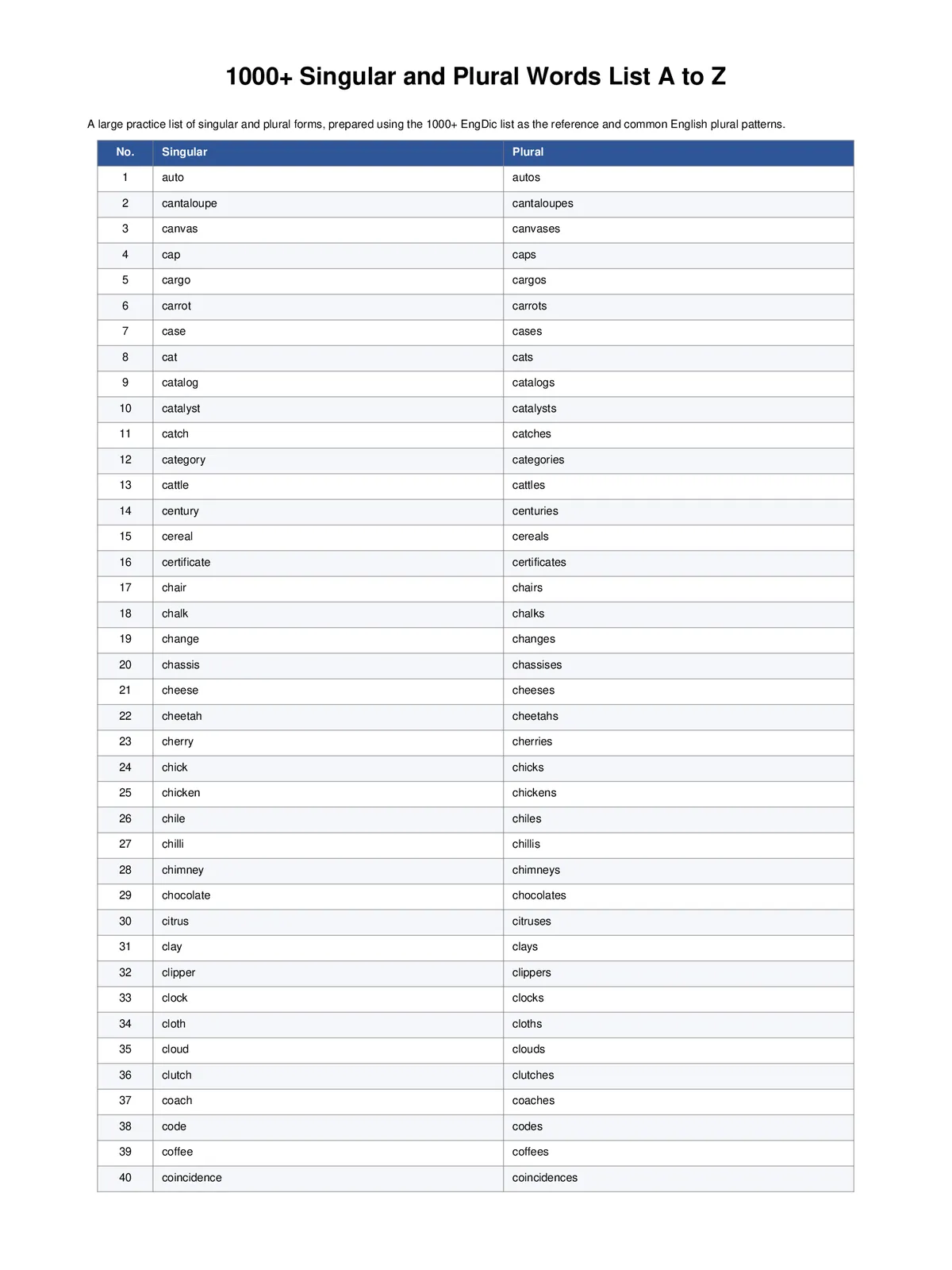
A to Z Comprehensive Singular and Plural Words List
Below is a curated table of common and important singular and plural words frequently asked in competitive exams and school tests:
| Singular Noun | Plural Noun | Category / Rule Applied |
| Analysis | Analyses | Greek ending (-is → -es) |
| Antenna | Antennae / Antennas | Latin / Regular |
| Appendix | Appendices | Latin ending (-ix → -ices) |
| Axis | Axes | Greek ending (-is → -es) |
| Baby | Babies | Consonant + y → -ies |
| Bacterium | Bacteria | Latin ending (-um → -a) |
| Cactus | Cacti / Cactuses | Latin ending (-us → -i) |
| Calf | Calves | Ending in -f → -ves |
| Cherry | Cherries | Consonant + y → -ies |
| Child | Children | Irregular plural |
| Crisis | Crises | Greek ending (-is → -es) |
| Criterion | Criteria | Greek ending (-on → -a) |
| Curriculum | Curricula | Latin ending (-um → -a) |
| Datum | Data | Latin ending (-um → -a) |
| Deer | Deer | Zero plural (unchanged) |
| Diagnosis | Diagnoses | Greek ending (-is → -es) |
| Echo | Echoes | Consonant + o → -es |
| Elf | Elves | Ending in -f → -ves |
| Focus | Foci / Focuses | Latin ending (-us → -i) |
| Foot | Feet | Vowel mutation (oo → ee) |
| Fungus | Fungi | Latin ending (-us → -i) |
| Goose | Geese | Vowel mutation (oo → ee) |
| Half | Halves | Ending in -f → -ves |
| Hero | Heroes | Consonant + o → -es |
| Index | Indices / Indexes | Latin ending (-ex → -ices) |
| Knife | Knives | Ending in -fe → -ves |
| Leaf | Leaves | Ending in -f → -ves |
| Life | Lives | Ending in -fe → -ves |
| Loaf | Loaves | Ending in -f → -ves |
| Louse | Lice | Irregular plural |
| Man | Men | Vowel mutation (a → e) |
| Matrix | Matrices | Latin ending (-ix → -ices) |
| Medium | Media | Latin ending (-um → -a) |
| Memorandum | Memoranda | Latin ending (-um → -a) |
| Mouse | Mice | Irregular plural |
| Nucleus | Nuclei | Latin ending (-us → -i) |
| Oasis | Oases | Greek ending (-is → -es) |
| Ox | Oxen | Irregular plural (-en) |
| Person | People / Persons | Irregular plural |
| Phenomenon | Phenomena | Greek ending (-on → -a) |
| Potato | Potatoes | Consonant + o → -es |
| Radius | Radii | Latin ending (-us → -i) |
| Scarf | Scarves / Scarfs | Ending in -f → -ves |
| Series | Series | Zero plural (unchanged) |
| Sheep | Sheep | Zero plural (unchanged) |
| Species | Species | Zero plural (unchanged) |
| Stimulus | Stimuli | Latin ending (-us → -i) |
| Syllabus | Syllabi / Syllabuses | Latin ending (-us → -i) |
| Thesis | Theses | Greek ending (-is → -es) |
| Thief | Thieves | Ending in -f → -ves |
| Tooth | Teeth | Vowel mutation (oo → ee) |
| Volcano | Volcanoes / Volcanos | Consonant + o → -es |
| Wife | Wives | Ending in -fe → -ves |
| Wolf | Wolves | Ending in -f → -ves |
| Woman | Women | Vowel mutation (a → e) |
Common Grammar Traps & Examination Notes
- Nouns Always Plural: Some nouns exist only in plural form and take plural verbs: Scissors, Trousers, Glasses, Spectacles, Binoculars, Tongs, Pliers, Clothes, Thanks (e.g., “My scissors are sharp”).
- Plural in Form, Singular in Meaning: Certain nouns look plural because they end in ‘-s’ but are singular and take singular verbs: News, Mathematics, Physics, Economics, Politics, Ethics, Measles, Mumps, Billiards, Innings (e.g., “Mathematics is an interesting subject”, “The news is true”).
- Uncountable Nouns (No Plural Form): These nouns never take an ‘-s’ and cannot be counted directly: Information, Furniture, Advice, Luggage, Baggage, Scenery, Poetry, Machinery, Hair (e.g., say “pieces of information” or “items of furniture”, never “informations” or “furnitures”).
Download Singular and Plural Words List PDF: You can download the complete A to Z Singular and Plural words list and grammar rules sheet in PDF format using the download link below for offline study.